Introduction
The new Water Law in Georgia will come into force in September 2026, laying the foundation for harmonising the country’s water policy with the best international and European Union practices. The enforcement of the bill is directly dependent on the technical regulations that must be operational by September 1st and must also comply with international practices. The new law will concern:
- Drinking water quality
- Wastewater management
- State accounting of water resources.
The new Water Law includes multiple standards and methodologies, based on which the water quality and accounting methodologies are formulated and verified. They ensure measurement accuracy, the hygienic and functional safety of devices, and data reliability.
The purpose of this blog is precisely to review these standards using the example of Germany—a country that is a global leader in sustainable water resource management and technological standardisation. Its goal is to introduce you to a ready-made framework for integrating ISO/EN standards into national legislation.
The blog is intended for both legislators and regulatory bodies, as well as consumers, to create a common technical language for the effective implementation of new regulations.
Brief Overview of Standards:
- Safety standards
- Data reliability
- Functional safety of devices
- Environmental monitoring standards
- Water analytics
- General management standards
Safety Standards
KTW/DVGW/W270 certificates, required by German law, ensure that materials used in the device are safe for human health and do not alter the properties of drinking water.
- KTW – The German standard for plastic materials and drinking water consists of the guidelines of the German Environment Agency (UBA), which verify the chemical safety of materials in contact with drinking water.
- The DVGW (German Technical and Scientific Association for Gas and Water) certificate confirms the device’s compliance with all technical and hygienic requirements.
- The W270 certificate confirms that the growth of microorganisms on the surface of the device is reduced to a minimum.
In accordance with Article 14 of the German Drinking Water Ordinance – TrinkwV, the materials of water meters must meet these requirements, providing a guarantee that the device will not contribute to bacterial contamination in the water supply system.
DVGW technical rules relate to and rely on the DIN EN ISO 4064 standard and state that water meters are subject to the verification requirements of MessEG, the German Federal Law on Measurement and Calibration. (The DIN EN ISO abbreviations indicate that the document is adopted simultaneously at three levels – International (ISO), European (EN), and German (DIN)).
Data Reliability
For commercial accounting and legal metrology, the technical and legal requirement of MessEG is the compliance of water meters with the MID MI-001 and OIML R49 standards. This ensures the accuracy and stability of the device, which is a necessary condition for the legal accounting of water consumption in Germany.
MID is the European Union’s “Measuring Instruments Directive,” official number 2014/32/EU, and OIML is the International Organization of Legal Metrology.
OIML R49 is the primary international standard for drinking water meters, which defines metrological and technical requirements and is considered equivalent to ISO 4064-1. These requirements are verified in accordance with the EU Measuring Instruments Directive, MID, in this case via the MI-001 module.
Compliance of devices with MID requirements is ensured by the conformity assessment service of the German National Metrology Institute – PTB.
According to the guide of the European Cooperation in Legal Metrology, WELMEC, compliance with the ISO 9001 quality standard creates a condition that the manufacturer’s quality system is in alignment with MID requirements.
The ISO/IEC 17025 standard is also noteworthy, as it establishes the requirements for the competence of calibration laboratories. This is a specific quality mark for precise measurements.
The use of calibration laboratories with ISO/IEC 17025 accreditation ensures the PTB traceability of these companies’ meters, which is a major commercial advantage for B2B municipal tenders.
Functional Safety
The SIL 2/3 (IEC 61508) standard confirms that in high-tech industrial and municipal environments, the company remains committed to functional safety and the management of critical processes.
SIL (Safety Integrity Level) is based on the IEC 61508 technical standard (and its analogue for the process industry – IEC 61511), which regulates the functional safety of electronic, electrotechnical, and programmable electronic safety systems.
Companies produce SIL-certified variants of their products for processes where device failure could cause significant environmental pollution or pose a threat to human life.
SIL 2/3 ratings are typically found in instruments designed to measure flow, level, pressure, and temperature. For German tenders or safety-critical projects, consumers must specify the exact SIL-certified variant and part number.
For maximum safety, SIL-certified devices are often used in conjunction with ATEX/IECEx certificates, which ensure the proper functioning of instruments in the industrial and wastewater sectors.
These certificates are for monitoring processes where hazardous substances or sewage gases may create an explosive environment. Compliance with ATEX/IECEx depends on the model and configuration.
Environmental Monitoring
Compliance with the requirements of the UBA and the Technical Inspection Association (TÜV) signifies rigorous fitness testing of automated measuring systems. The Monitoring Certification Scheme – MCERTS certificate confirms the reliability of continuous, online water monitoring devices for use in industrial and municipal wastewater.
Compliance with these standards is mandatory and integrated into German law (AbwV), which is the legal basis for wastewater monitoring.
Additionally, TÜV/UBA is specifically required for systems that perform automated reporting to environmental authorities. It confirms that automated systems provide measurements equivalent to manual measurement methods compliant with DIN/ISO standards.
The World Meteorological Organization (WMO) Standard No. 8 (WMO Guide to Instruments and Methods of Observation) is the global technical basis for environmental monitoring.
The WMO No. 8 standard defines sensor methodology and technical specifications, which are necessary for the analysis of long-term climate and environmental trends. This is a guarantee for obtaining consistent and high-quality data in hydrology and meteorology.
To ensure long-term compliance with WMO observation methods in field conditions, these tools typically possess an IP68 rating, which guarantees their long-term uninterrupted operation in water.
As for ISO 748, this is the technical standard for hydrometry, which regulates the measurement of liquid flow in open channels.
The integration of WMO No. 8 and ISO 748 standards into the German regulatory environment occurs through the LAWA-Pegelvorschrift (Instructions for Water Level Measurement). LAWA instructions define the data quality that is mandatory for federal and regional monitoring networks.
Possession of these standards is proof that these companies’ sensors meet high accuracy classes – typically with an error of < 0.05% Full Scale (FS), which is necessary for official German hydrometric accounting.
To meet the requirements of German state agencies, companies must align their data acquisition, calibration, and standard operating procedures with ISO/DIN standards, in which ISO 748 is one of the main pillars.
Water Analytics
Turbidity
The EN ISO 7027 standard is the primary technical norm for turbidity measurement, ensuring the compliance of analytical devices with the strict legal requirements of German drinking water.
According to Annex 5 of TrinkwV, compliance with the “Generally Recognized Rules of Technology” (a.a.R.d.T.) is legally implied if the DIN EN ISO 7027 standard is observed.
In municipal tenders for drinking water quality, a company is obliged to submit a document confirming that the instrument complies with the EN ISO 7027 standard.
Sensory Parameters – Colour, Odour, Taste
In Germany, these parameters are regulated by TrinkwV, and their evaluation methodology is based on international standards: Colour – ISO 7887, Taste – ISO 3972, and Odour – ISO 13301.
Anionic Surfactants and Petroleum Products
These substances, which are also provided for in TrinkwV in the case of drinking water, are regulated at the international level by ISO 6107 and ISO 13357 standards, respectively.
Total Organic Carbon (TOC)
EN 1484 is the primary technical and legal standard for the determination of TOC.
Annex 5 of TrinkwV directly specifies the DIN EN 1484 standard, compliance with which legally means that the TOC measurement method is automatically considered in compliance with the law.
General Management Standards
ISO 9001, 14001, and 45001 management standards create a common fundamental framework system, including for organizations involved in water resource management. They ensure the fulfillment of legal metrology requirements and market readiness status for the German market.
- ISO 9001 – Quality Management Standard. It defines how a quality management system (QMS) should be established, implemented, maintained, and continuously improved. In the direction of legal metrology (MessEG), it is technically important for compliance with MID modules D or H1. According to the WELMEC guide, possession of ISO 9001 creates a presumption of compliance with these modules.
- ISO 14001 – Environmental Management Standard, used for a strategic approach to environmental issues. It defines criteria for environmental management systems.
- ISO 45001 – The flagship of occupational health and safety standards, which ensures the reduction of risks in the workplace and safe working conditions.
ISO 9001, 14001, and 45001 standards oblige companies to develop technical innovations within a stable and audited corporate environment.
Although possession of these certificates is not a mandatory requirement of TrinkwV, they are critically important for conducting business activities in the country. Possession of these management standards represents a sign of the supplier’s high qualification for German government agencies and utility companies.
These standards create an organizational framework for technical compliance with strict norms such as EN ISO 7027 and EN 1484. By possessing them, a company confirms that its products and calibration services (with < 0.05% FS accuracy) are fully compatible with the AbwV and TrinkwV environment.
Conclusion
The aforementioned standards and regulations can be grouped as follows:
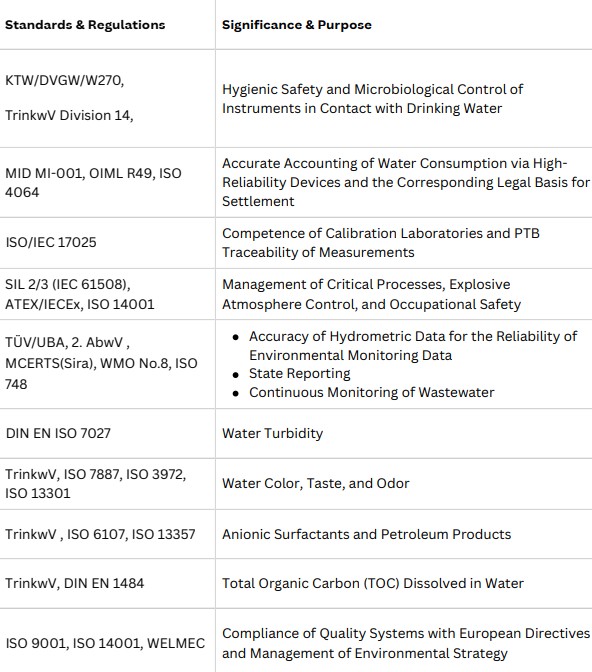
Since the new Water Law was created in harmonisation with EU practices, the technical regulations to be issued before September 1, 2026, will likely comply with these practices. This change is not only a challenge but also an opportunity for Georgian companies to ensure sustainable management of water resources and minimize environmental damage to the maximum extent.
VORTEX Water Engineering, which cooperates with the world’s leading water engineering companies, has been successfully implementing these technologies for years. The company provides the design, installation, commissioning, calibration, verification, and subsequent service of water treatment and analytical systems, which is done in cooperation with engineers from HACH, KROHNE, In-Situ, Nijhuis Saur Industries, VEOLIA, and other partners.