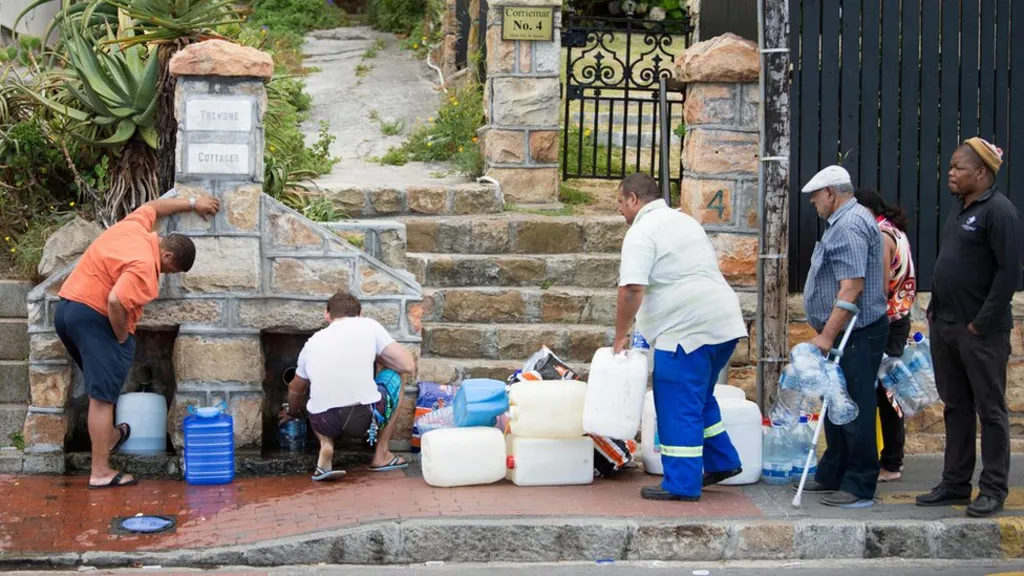
In 2018, Cape Town was teetering on the edge of a catastrophe known as “Day Zero” — the moment when, for the first time in modern history, a major global city’s water supply would run completely dry, leaving over 4 million people without running water.
However, instead of surrendering, the city met the disaster with unprecedented mobilization. Through a combination of aggressive public campaigns, radical tariff restructuring, and innovative engineering, Cape Town managed to overcome immense obstacles and save its citizens from the dreaded water queues.
In Cape Town, approximately 80% of public water usage is domestic. The city relies almost entirely on six major surface reservoirs, which recharge during the winter rainy season (May to August).
The crisis began in 2015 when reservoir levels started to plummet. Climate change had shifted rainfall patterns, pushing the region to a critical tipping point. After two consecutive dry seasons, the alarm was sounded in 2017: Cape Town was on track to hit “Day Zero” in 2018, necessitating a total shutdown of the municipal tap system.
At the height of the crisis, reservoirs hovered at an average of 28% capacity. “Day Zero” was defined as 13.5% — the threshold below which extracting water becomes technically unfeasible, forcing residents to queue at guarded standpipes for a daily ration.
Economic Levers
There are 7 levels of water tariffs in the city, where Level 2 represents normal tariffs, and as the water level in the reservoirs decreases, the tariffs move to higher levels. Level 7 is the tariff corresponding to Day Zero, when the public water supply is shut down.
In February 2017, during the water crisis, the situation escalated and rose from Level 3 to Level 6 by February 2018. Among middle-class consumers, from March 2015 to March 2018, the average price of water increased by 230%, despite a sharp decrease in consumption, while in the highest consumption block, it increased by 2000%.
It should also be noted that the price of water consumption was based on an increasing block tariff, which is designed to cover both fixed and variable costs. A block tariff is a pricing structure where the unit price of water increases as the volume of consumed water increases. It aims to both encourage water conservation and provide cross-subsidization from wealthy households (who are expected to consume more) for the benefit of less wealthy households.
Social Mobilisation & Behavioural Change
Active information campaigns were carried out to reduce water consumption, within the framework of which an online guide on water saving was distributed.
The population switched to using showers instead of baths, and for garden irrigation, they began collecting household secondary water and rainwater. In addition to saving resources, this approach also reduced the imposed water bills. It is noteworthy that between 2015 and 2018, water tariffs also increased sharply.
Other initiatives were also implemented to solve the crisis:
- A water resource monitoring platform was published, where the water consumption rate and information about the water level in the reservoir were updated weekly.
- The “watermap” was launched, where each house was marked in different colors according to the level of water consumption. Consequently, a social pressure factor was involved for those residents who consumed excessive water.
- Electronic signs were added to highways, showing how many days were left until “Day Zero.”
- Businesses began encouraging customers to save water. For example, hotels removed bathtub plugs, making it impossible for guests to fill the bathtubs. Additionally, hotel staff urged them to take only 1-2 minute showers.
A clear response from the population followed the publication of the “Critical Water Shortage Disaster Plan,” which was issued in 2017. The plan accounted for the risk of water supply depletion, the possibility of limited distribution at special drinking water points, and the risks of fires and disease outbreaks in informal dense settlements. If the imposition of restrictions had previously led to an increase in water consumption, the publication of the plan caused panic, and the population began to follow the published advice in response.
Researchers from the Environmental and Economic Policy Research Unit monitored the effects of various interventions. According to them, it is difficult to determine which step was the most effective, as they were implemented either simultaneously or at short intervals. However, behavioral changes are evident.
Engineering Innovations
The crisis acted as a catalyst for technical breakthroughs:
- Technical water desalination solutions (reverse osmosis systems) were specially installed (once the site is ready, we can link to our reverse osmosis systems).
- Improved schemes for the reuse of treated wastewater were developed, creating alternative ways to obtain technical water.
- Automatic pressure regulators were installed in the city, which significantly reduced water leaks and pipe bursts.
- Abstraction of water from deep layers occurred, and it was integrated into the city’s general system.
- Full metering of water supply and sanitation systems was carried out using electromagnetic meters. In parallel, pressure control instruments were installed in the pipes.
One of South Africa’s largest corporations, Old Mutual, created its own water filtration system in response to the crisis, which allowed the company to completely exit the central water supply network. Consequently, the load on the municipal network decreased.
It took less than a year for Old Mutual to create and put into operation a system for converting wastewater into drinking water; at that time, the company’s employees working on one campus (9,000 people) had already reduced their water consumption by 30%. Now, approximately 75% of the water on the campus is reused or processed, and the rest is lost in the system.
Lessons from the Brink
By February 2018, the collective effort began to show results. “Day Zero” was pushed back repeatedly until the arrival of the winter rains officially cancelled the threat.
Cape Town’s crisis was a global wake-up call, proving that climate change and water scarcity are not distant dystopias but immediate realities. The key takeaways are clear:
- Climate Resilience: Water management must be proactive and based on long-term climate projections.
- Radical Transparency: When citizens have real-time data on resources, their sense of collective responsibility increases.
- Collective Power: Cape Town proved that individual behavioral changes, when scaled across 4 million people, can achieve the impossible.