Purchasing high-tech laboratory equipment in the water supply, wastewater management, or environmental monitoring sector is a significant investment. Often, the procurement process focuses primarily on the initial price of the device, while its subsequent technical maintenance is perceived as unnecessary.
In reality, the purchase is only the beginning of the investment. Any optical measuring instrument consists of wear-and-tear parts that lose accuracy over time, even when the device outwardly appears to operate continuously.
Purchasing a spectrophotometer without a service plan creates both financial and operational risks. An error in water quality analysis means not only repeating tests, but also non-compliance with regulations, loss of laboratory accreditation, fines, and reputational damage.
What Happens to Optics and Wear-and-Tear Parts
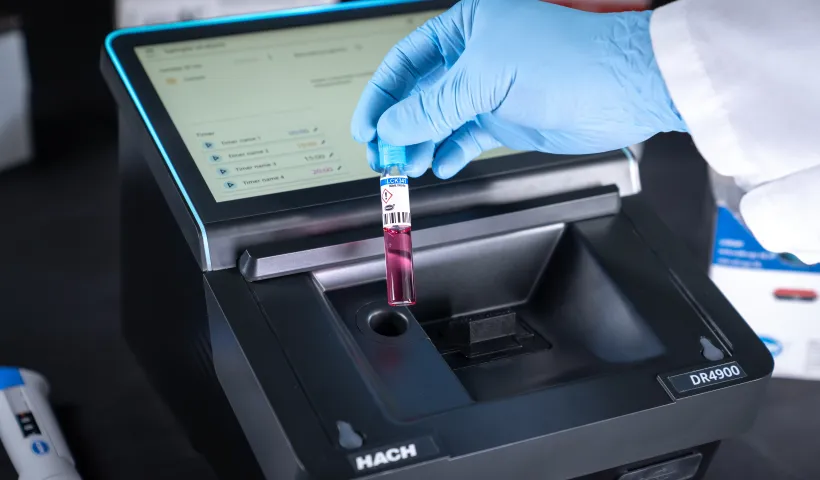
Accuracy requires regular support. Any high-precision optical instrument undergoes physical and optical wear over time. High-tech devices such as the HACH DR4900 and DR6000 require regular calibration and part replacement during operation. To maintain the optical accuracy of the devices, it is necessary:
- In the case of the DR4900: Replacing the Lens Set every 12 months.
- In the case of the DR6000: Regular replacement of the filter pad, halogen, and deuterium lamps (for example, lamps are replaced based on operating frequency). The filter pad is replaced on average 1 time per year, the drive ring — 0.5 times, the halogen lamp — 0.3 times, and the deuterium lamp — 0.25 times per year. These figures are averages and depend on the device workload.
- Mechanical and electronic components: Parts of the cuvette holder mechanism, such as the Drive Ring / Driving Collar, experience constant mechanical friction and need to be replaced on average every 12-24 months.
Without technical maintenance, these components fail, at which point the device will simply provide inaccurate results.
Regulatory and Quality Compliance
For a laboratory, instrument accuracy is a regulatory requirement and a prerequisite for accreditation. The latter is official confirmation that the laboratory is competent and provides accurate, manipulation- and error-free results compliant with international standards. For both of the above devices, HACH offers several types of services, of which the most complete package includes:
- Replacement of wear-and-tear parts;
- Checking the accuracy of stray light, photometry, and wavelength — parameters that directly determine the measurement result;
- Precise calibration and cleaning of optics and camera;
- Software updates;
- Device verification;
- Issuance of a performance and compliance certificate upon completion of the service, confirming the fulfillment of regulatory requirements and ISO standards.
Only authorized HACH service can issue a certificate of compliance with ISO standards, confirming that the device meets measurement accuracy requirements. Upon completion of the service, a service report and a performance certificate are issued, which are an integral part of the audit and quality management system.
- ISO/IEC 17025 (General requirements for the competence of testing and calibration laboratories): This is the main standard for laboratories. It requires that all measuring equipment be regularly calibrated, have traceability, and equipment errors be documented. The HACH service certificate is critically necessary precisely to pass the ISO 17025 audit. It confirms the competence of testing and calibration procedures.
- ISO 9001 (Quality management systems): The general quality management standard. It requires that the enterprise or laboratory have a prescribed, preventive plan for equipment maintenance and calibration.
- Good Laboratory Practice — which ensures the uniformity, consistency, reliability, and reproducibility of research, quality, and integrity — accreditation.
Upon completion of the annual preventive service, a certificate of compliance and a service report are issued, which serve as official documents for regulatory bodies and audits and simplify passing accreditation.
Choosing the HACH Service Plan ensures process continuity:
- Priority response and technical support: Quick remote diagnostics of problems via the hotline.
- Financial predictability: Within the framework of the service agreement, wear-and-tear parts and replacement work are included in the package, which eliminates unexpected costs and makes annual budget planning easier.
Conclusion: VORTEX Service Support as a Guarantee of Reliability
Purchasing a device together with a service plan is not an additional cost, but an investment in data reliability, long-term equipment viability, and peaceful operational activity, which will ultimately help save budget.
VORTEX Water Engineering, as the official partner of HACH in the South Caucasus region, offers full technical support — preventive maintenance, certified calibration, spare parts, and operational continuity. We ensure not only the supply of high-tech devices, but also their subsequent scheduled service, certification of compliance with ISO standards, and qualified engineering support.